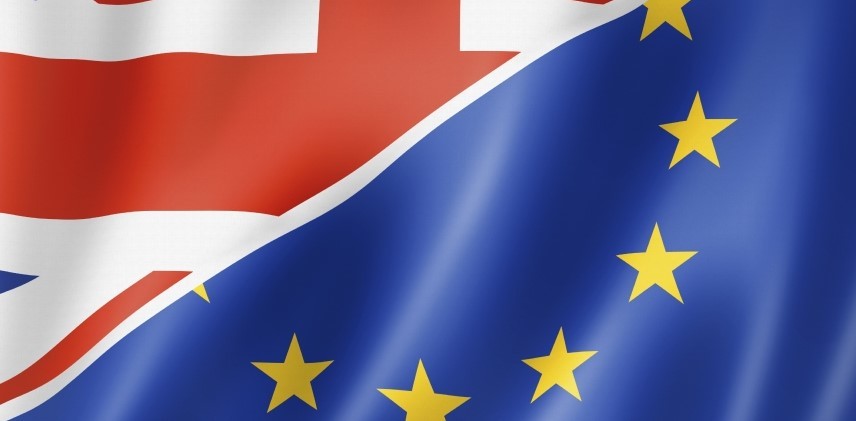
The day of BREXIT
... and why today's economic challenges go beyond

So BREXIT is happening… a decision that will change Europe for years to come, but one that has to be respected as the outcome of a democratic vote. There's probably enough being written and said about this today, and it's not really any different than what was said in the past months. Interesting times are ahead of us, and no one really knows what's going to happen.
However, the discussion around economic growth in case of BREXIT reminded me of two TED talks I recently watched on the sustainability of economic growth. They are focused on the US economy, but the lessons largely apply to any developed economy (whether part of the EU or not - just to close that topic).
On the one side of the discussion, Robert J. Gordon argues that economic growth of the past can't be sustained in the future because of the "headwinds" that would need to be overcome. Simplifying his talk, he says that in order to grow at the same pace an economy would need to innovate at the same rate as in the past. But in addition, today the headwinds of changing demographics, rising costs of education, rising debt, and increasing inequality are all negatively impacting economic growth. Hence, in order to sustain growth, innovation would need to outpace the decline caused by the headwinds.
On the other side, Erik Brynjolfsson's argument promotes the idea that new innovation, complementing general purpose technologies, will continue to provide growth as it did in the past industrial revolutions (1st steam, 2nd electricity). Today's 3rd industrial revolution provides us with computers and brings us to what he calls the "new machine age". This environment innovation allows to provide services (and to some extent goods, of course) at low marginal costs. In that sense, productivity is increasing but services are provided almost for free and their true value therefore not measured by GDP. He concludes that we need to reinvent the organizational setup to adapt to the new machine age, for example by decoupling productivity from employment and wealth from work.
What seems to be two contradicting arguments is in my view the same argument looked at from different perspectives. What I take away from it is...
- firstly, the existing measures of economic production (mainly GDP) are insufficient to measure actual production. Economists knew about the issues of measuring output by GDP for a long time, but the technological development and production at low marginal costs (but high benefits) amplifies those deficiencies.
- secondly, the big question is how we will deal with the need for fewer human input and lower marginal costs of production this time (compared to the past two industrial revolutions). It's the question around the concept of a society with (near) "zero marginal costs" for many goods - I won't open this box of the pandora here but rather spend more time on it some other day.
- and finally, I can't get around mentioning the topic of inequality, as it is either explicitly or implicitly touched upon by both talks. This one ties back to the BREXIT discussion… and the US elections… and the rise of right-wing populist parties in many European countries. What is becoming very clear to me in all those cases is that there is a large number of people that feel excluded from economic growth, and figures on income inequality in some cases support their views. How will Brynjolfsson's "new machine age" and Gordon's "low GDP growth era" impact our economic and social systems?
May be the answers are already out there and I just didn't see them. But if not, I guess there's enough material to think about for the next few years... BREXIT will bring challenges, but the underlying sentiments and social issues in many countries go beyond that and require even more drastic changes.
Cover image credit: https://www.google.com/url?sa=i&rct=j&q=&esrc=s&source=images&cd=&cad=rja&uact=8&ved=0ahUKEwiJue25lMDNAhXJVhQKHROVBy8QjB0IBg&url=http%3A%2F%2Fwww.ibtimes.co.uk
